FOLKLORE
Jinn Were Never Lamp-Bound Wish Merchants, Art Platform Argues; Medieval Baghdad Painted Them Tending Bath Furnaces
An essay from Exhibo Art Platform, flagged by The Anomalist, sets out to separate the hidden ones of Arabian tradition from the blue, joke-cracking genie of animation.
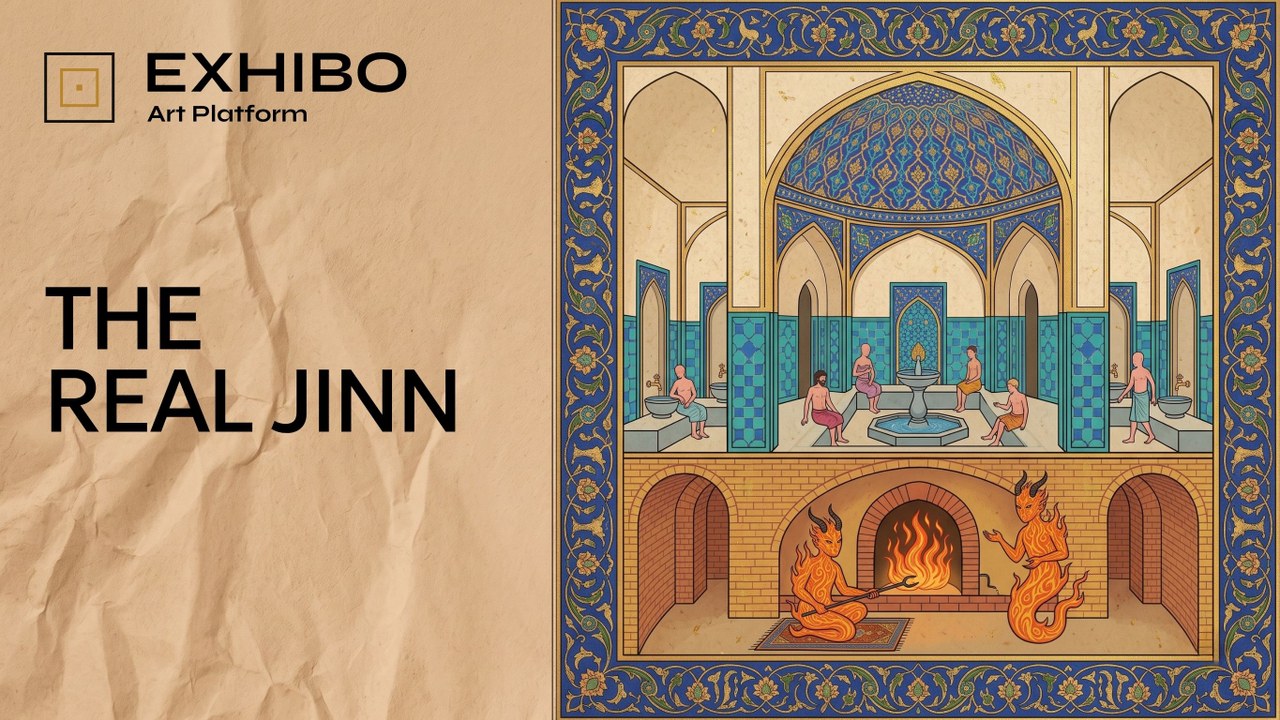
OXFORD, ENGLAND — A fourteenth-century manuscript in Oxford shows two jinn working below the public baths at Tiberias, according to an essay published by Exhibo Art Platform and noted by The Anomalist. The drawing, on folio 35v of the Book of Surprises, is a cutaway: bathers above, and below them a furnace tended by two jinn who appear to be deep in conversation. There is no bargain and no punishment, the essay observes.
The manuscript, catalogued at the Bodleian Library as MS. Bodl. Or. 133, was compiled in Jalayirid Baghdad at the end of the fourteenth century. The essay credits it with what may be the most remarkable surviving sequence of jinn paintings. The Anomalist's summary, initialed CM, relays the author Alena Belova's argument that Disney's Aladdin of 1992 invented the three-wishes contract, while the flying carpet came from a Syrian storyteller living in Paris.
The essay begins with the word itself. The Arabic root j-n-n, it explains, carries the sense of covering or hiding, and gives words for garden, for madness and for the foetus. The jinn are therefore, in the author's phrase, the concealed. The English word genie, the piece says, arose when Antoine Galland, translating the Nights into French between 1704 and 1717, reached for génie, a Latin term for a household spirit, simply because it sounded similar.
On pre-Islamic belief, the author cautions that most accounts come from scholars writing centuries later, and sets against them the Safaitic rock inscriptions studied by Ahmad al-Jallad. From this material the essay draws a picture of jinn as owners of unclaimed ground, such as ruins, wells and certain trees, where the proper conduct is to announce oneself politely. Poetry, it adds, was credited to attendant spirits.
The essay says the Qur'an addresses jinn as a community inside the same moral order as people, rather than as powers to bargain with. It then turns to the ninth-century Basran scholar al-Jāḥiẓ, who in the Book of Animals graded jinn by disposition and strength, a ladder the author traces to modern fantasy games. The source text breaks off there, and the author notes that horror films in Turkey and Iran still draw on this tradition without a single wish being granted.