WIRE COPY
Hints Of Star Population That Failed To Explode
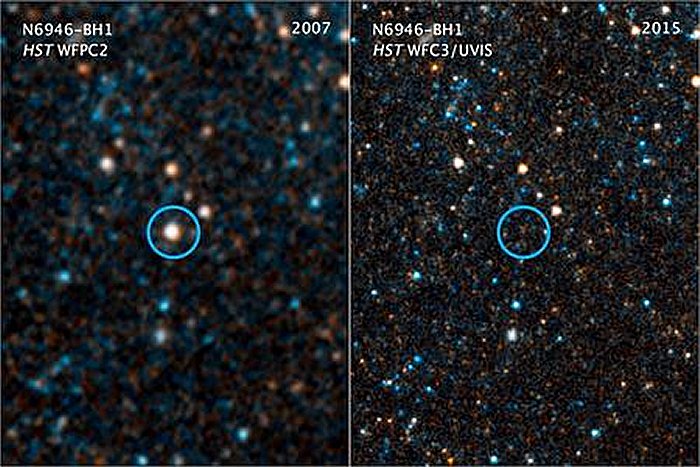
Eddie Gonzales Jr. – MessageToEagle.com – When the most massive stars in the universe die, they often explode as supernovae, blasting most of their matter into space. The remaining stellar cores collapse into neutron stars and, sometimes, black holes. However, theories suggest some massive stars might die without a bang, instead collapsing directly into neutron stars or black holes.
These pictures taken by NASA’s Hubble Space Telescope in 2007 and 2015 show an example of a star thought to have died via a failed supernova. A giant star N6946-BH1 is seen before and after it vanished out of sight, likely after imploding to form a black hole. Credit: NASA/ESA/C. Kochanek (OSU)
Now, a new Caltech-led study using data from the LIGO–Virgo–KAGRA network of gravitational-wave observatories finds hints of a distinct population of black holes that may have formed from such failed supernovae. While the study did not find direct evidence for failed supernovae, it does show that previous gravitational-wave observations match what theorists had predicted for such a population.
LIGO, the National Science Foundation (NSF)-funded Laser Interferometer Gravitational-wave Observatory, which consists of detectors in Louisiana and Washington, made history in 2015 with the first direct detection of gravitational waves, or ripples in space-time, from a pair of colliding black holes. …