ANCIENT ENIGMAS
Sphinx Rock Yields Long-Snouted Crocodile Missing Its Nose, Like the Sphinx Itself
Researchers name a 45-million-year-old gavial Herugavialis cairensis after reexamining skull fossils unearthed in the 1920s and long mistaken for a living species.
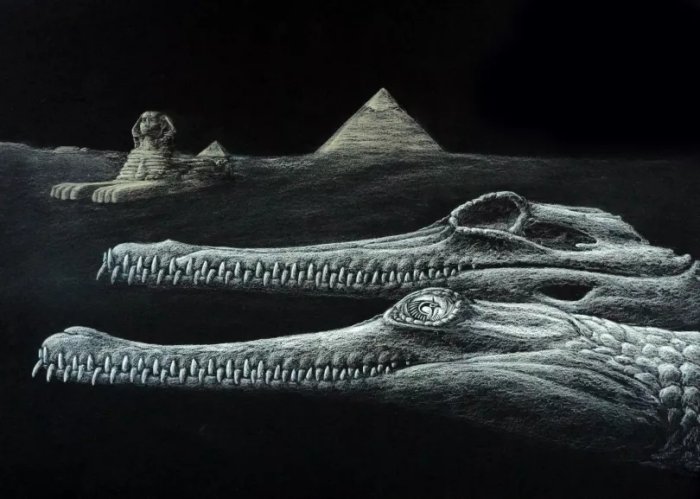
GIZA, EGYPT — A new species of prehistoric sea crocodile has been identified from fossils found in the same rock formation from which the Great Sphinx of Giza was carved, according to a report by MessageToEagle. The animal has been named Herugavialis cairensis.
The report notes a curious coincidence: the skull is missing the tip of its snout, just as the Sphinx is missing the tip of its nose. Co-author Professor Philip Mannion of UCL Earth Sciences said the team named the creature after the god Heru, who was possibly the inspiration for the monument.
The animal is a gavial, one of a group of fish-eating crocodiles with long, thin snouts. Only two species survive today, in the Indian subcontinent and Southeast Asia, and both are critically endangered. The fossil record, the report says, shows gavials once ranged across much of the world over more than 100 million years.
The specimens, including a nearly complete skull, were found in the 1920s in the Mokattam Formation, which is 45 million years old. They were then misidentified as the living "false gharial," Tomistoma schlegelii. A team from the UK, Sweden, Germany and Egypt used CT scanning to look inside the skull and found distinguishing features, among them a raised ridge around the eyes.
Lead author Dr Paul Burke said the Mediterranean region hosted a high diversity of crocodiles for much of the last 50 million years, with their numbers apparently tracking global temperature and sea level. About six million years ago, he said, the sea was cut off from the Atlantic and dried up, and the region lost all its crocodiles. The skull is held at the State Museum of Natural History in Stuttgart and was first described in a 1927 study by Lorenz Müller.