ANCIENT ENIGMAS
Hampshire Church Yields Labyrinth Hidden Beneath Altar Table for Over a Century
Heritage charity invites the public to help explain a 1,500-tile floor pattern and the curious behaviour of sunlight at St Mary's, Itchen Stoke.
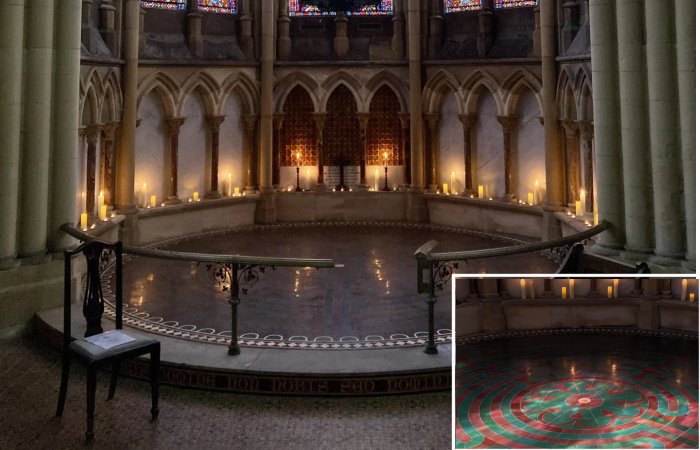
ITCHEN STOKE, ENGLAND — A redundant church in Hampshire has revealed a floor labyrinth that, according to Ancient Pages, went largely unnoticed for more than a century, and the Churches Conservation Trust is now asking the public for help in understanding it.
The 11-circuit design lies at the eastern end of St Mary's Church. It is described as roughly five metres across and made of about 1,500 glazed brown and green tiles, laid as a smaller copy of the medieval labyrinth at Chartres Cathedral in France. It is believed to be the only historic indoor church labyrinth in the United Kingdom. The article says the Conybeare brothers commissioned it, and that it was built between 1866 and 1867.
For much of its modern history, the report states, the pattern sat beneath a heavy wooden altar table and was recorded merely as a geometric tile maze. Its full extent emerged only after the Trust, which has cared for the Grade II* listed building since 1971, removed the table.
The article distinguishes a labyrinth from a maze: the former has a single winding path, the latter branching routes and dead ends. At St Mary's the path ends at a yellow central ring. Such walks were, it says, a symbolic mini-pilgrimage for nineteenth-century worshippers unable to travel to the Holy Land.
The discovery has produced more romantic theories. Some researchers, the article says, suggest the building holds secrets akin to a real-life Da Vinci Code. Observers report that sunlight through the geometric stained-glass windows casts patterns on the apse floor and, at certain times of day, forms an arrow pointing to the labyrinth's heart. This has prompted speculation that the design may have been meant as an astronomical calendar or solar clock. No such purpose is established in the report.
The Trust has invited historians, researchers and amateur sleuths to offer insight into the apparent alignment of windows and tiles. The church, open daily, has no electricity or running water, and lies on the St James' Way pilgrim route between Reading Abbey and Southampton. The Trust holds occasional candlelit walking days on the labyrinth.