DEEP SPACE
Hubble Spies 'Cat's Tail' of Black Dust Trailing Young Star 63 Light-Years Distant
Astronomers say the long, dark feature at Beta Pictoris is likely the wreckage of a collision between large bodies, and its fluffy carbon grains remain a puzzle.
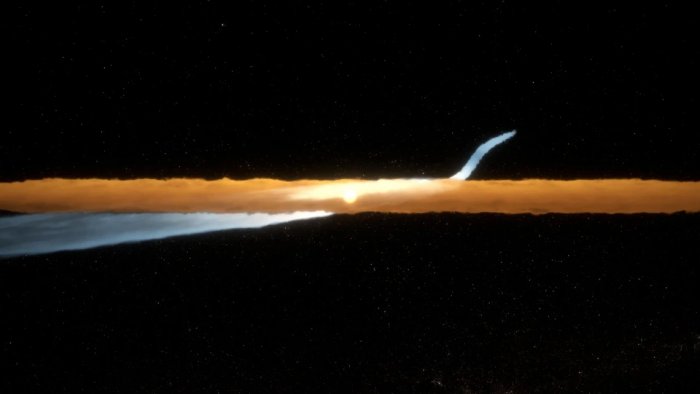
PICTOR, DEEP SPACE — Sixty-three light-years from Earth, in the faint southern constellation of Pictor, a dark streak of dust nicknamed the "Cat's Tail" has vexed astronomers for two years, according to a report from MessageToEagle. The structure is said to stretch across roughly a thousand times the distance between the Earth and the Sun.
The feature lies within the debris disk of Beta Pictoris, a star system described as much younger than our own, having formed only a few million years ago. For the first time, the report states, the tail has been captured in visible light by the Hubble Space Telescope. It had previously been seen only by the James Webb Space Telescope, which observes in infrared.
The findings, published in The Astrophysical Journal Letters, were led by University of Arizona planetary scientist Arin Avsar. Avsar said the tail is thought to be the aftermath of a collision between large bodies, something like Pluto. He attributes its long invisibility at shorter wavelengths to its makeup: almost entirely carbon-rich organic material that absorbs visible light and is therefore quite black.
The dust grains are micron-sized and unusually porous, or "fluffy," a combination Avsar said no one really understands. Co-author Kevin Wagner suggested that collisions may have been violent enough to vaporize the carbon, which then recondensed as porous grains on cooling.
Combining Hubble and Webb data with computer modeling, the team now suggests the tail may not extend behind the star, as once believed, but sideways across our line of sight. Hubble also revealed a warp in the surrounding dust halo, which the researchers believe is likely caused by Beta Pic b, a gas giant about ten times the mass of Jupiter.
Avsar says the system offers clues to our own early history, when the young Kuiper Belt may have held hundreds of Pluto-sized bodies before giant planets cleared many away.