ANCIENT ENIGMAS
Satyrs Cut Into a Stone Smaller Than a Fingernail Upend Ideas of Greek Stage Art
Researchers say a 2,100-year-old carnelian ring stone from the Gaye Çarmikli Collection shows a satyr play without masks, a departure from comparable gems.
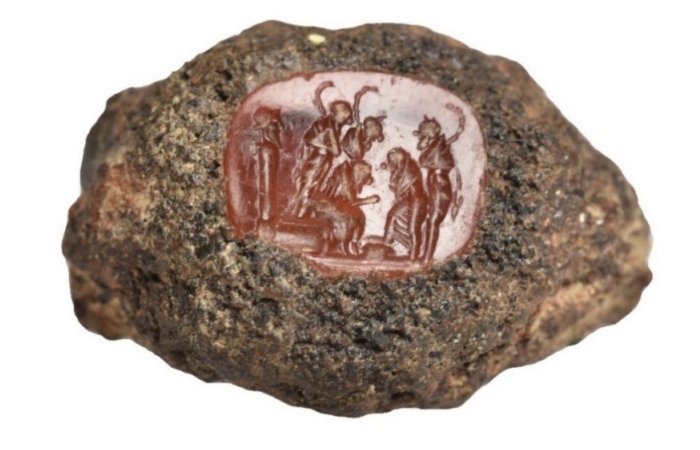
ANKARA, TÜRKIYE — A carnelian gemstone measuring 13 by 11 millimeters, set in a badly corroded iron ring, is drawing scholarly attention for the theatrical scene engraved upon it, according to a report by Ancient Pages. The piece belongs to the Gaye Çarmikli Collection and is registered as movable cultural property affiliated with the Ankara Ethnography Museum.
Researchers Melih Arslan and Ahmet Emirhan Bulut, writing in the journal Cedrus, date the intaglio to the first half of the 1st century BC. Under the microscope, they identified round-tipped drills used for body outlines, rotary abrasives for the folds of garments, and tiny pinpoint perforations for noses and faces.
The scene holds five main figures, a pillar and a small background figure. At the center, a long-robed man studies a two-leaf tablet, whom the authors take to be a poet or playwright reviewing a script. Opposite him stands a figure with a foot on a stone, a pose the report says is often linked to a chorus leader. The others carry horns, tails and curved staffs, marking them as satyrs. A bearded herm at left is read as Dionysus.
Behind the herm is a minute female figure with loose hair and outstretched arms. Arslan and Bulut propose that she is Thalia, Muse of comedy, though the researchers describe this as a strong hypothesis rather than a certainty.
The chief novelty, the authors argue, is the absence of masks. Comparable gems in the British Museum and the Rijksmuseum van Oudheden, the article says, show a backstage rehearsal, with masks pushed up on heads or held in hand. Here the actors appear as true satyrs, which the researchers take to mean a live performance or the myth behind it. The article calls this approach previously undocumented among known theatrical gems and reliefs.
The stone did not come from a controlled excavation. It passed through the private art market, and while its find-spot is unconfirmed, museum archival records suggest an origin near Sardis, in western Türkiye. The researchers propose an owner of high standing: a playwright, a leading actor or a wealthy patron of drama. The iron band has nearly vanished, but the gem, despite two hairline fractures, remains legible.