SKIES & SAUCERS
Remote Radio Source Defies Astronomers by Dimming, Brightening and Shifting Its Tune
VT J1906+0849, some 49,000 light-years away, has behaved unlike any known object over two decades, according to a new paper.
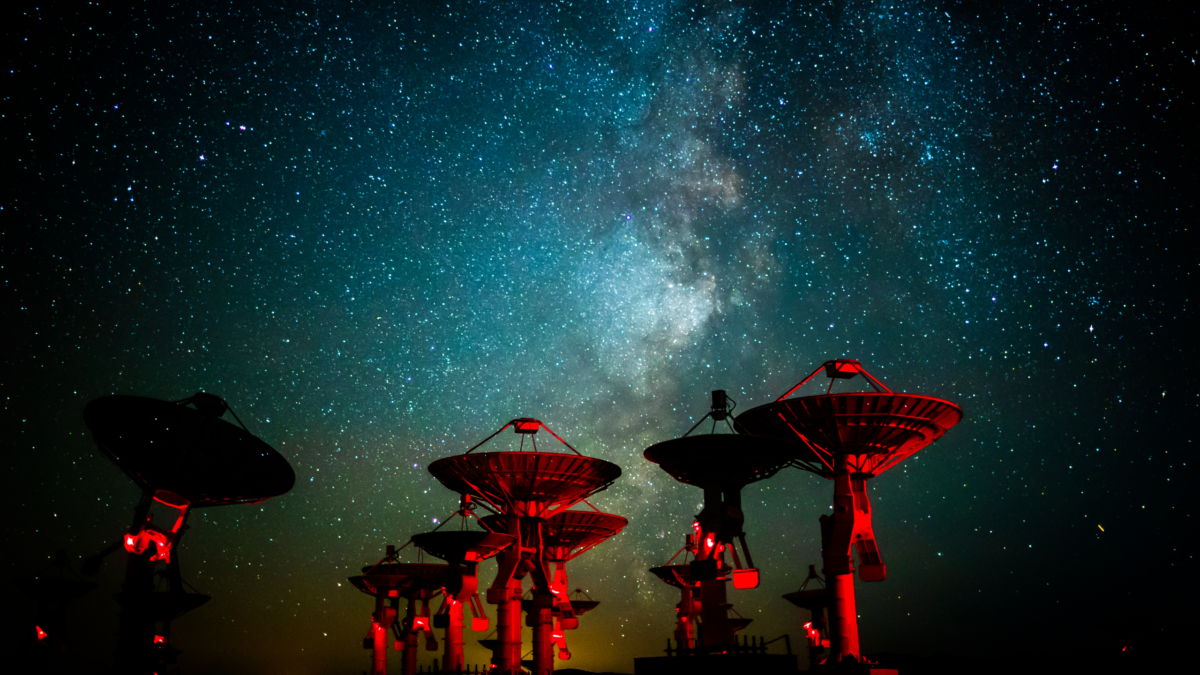
THE NORMA-CYGNUS ARM — A radio-bright object far beyond the Milky Way's outer Norma-Cygnus spiral arm is conducting itself in a manner no astronomer has previously recorded, according to a report by Michelle Starr for Science Alert, noted by The Anomalist.
The object, catalogued as VT J1906+0849, was first flagged in 2017 data from the Very Large Array Sky Survey. It was then the brightest radio transient that survey had found, at about 70 millijanskies. A 1996 survey, the report says, showed nothing at the site. By 2005 a change had begun, and the source peaked near 200 millijanskies in 2014.
One might have expected a quiet decline thereafter, and for a time that appeared to be the case: observations in 2019 and 2024 showed it growing fainter. Then, according to the article, it brightened again in late 2025.
The spectrum has proved equally contrary. The frequency at which the emission peaks stood near 1.9 gigahertz in 2019, fell to about 0.8 in 2024, and climbed to about 2.2 by 2026. An expanding cloud, the report notes, would be expected to drift steadily toward lower frequencies, yet researchers found little sign of expansion. A paper led by Jessie Miller of the California Institute of Technology describes it as a source that has remained radio-bright for roughly two decades.
The researchers weighed three explanations. A nova was ruled out, as was a pulsar-powered nebula, the latter for being too erratic. That leaves a black hole or neutron star drawing material from a companion. NASA's Swift telescope found none of the X-rays such a system should emit, though the article notes that a wind of dense material, as seen in the object SS 433, could hide them. Infrared observations showing gas moving at about 2,000 kilometers per second are said to be consistent with an outflow.
The article stresses that this is far from a confirmed identification, and that more observations are needed to learn whether the object is a younger relative of SS 433 "or something even stranger." The work is published in The Astrophysical Journal.